San Francisco Bay Area. Over 60 Different Kosher Wines in Stock.
The Wall Street Journal
- Friday, April 7, 2000
TASTINGS / By Dorothy
J. Gaiter & John Brecher
Choosing the Best Kosher Wines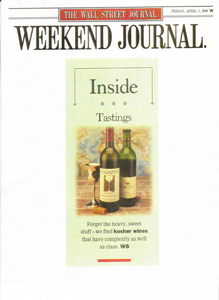
LAST YEAR about this time, we conducted an extensive tasting of kosher wines from all over the world. Everyone knows that kosher no longer means just heavy, sweet wines, but we wondered just how far they'd come. Our conclusion: Kosher wines had come a very long way. As we said then, there's no reason anyone should feel left out of the world of fine wine because they keep kosher.You Think Keeping Kosher
Means You Have to Forgo
Fine Wines? Think Again.
This year, we decided to take the next step - a blind tasting, head-to-head. We bought every kosher bottle we could find of four popular varietal: Merlot, Cabernet, Sauvignon, Chardonnay and Sauvignon Blanc. Our feeling was that these wines were good enough to stand up to a tough competition. We find that all wines show their strengths, and their flaws, more readily when they are tasted blind against each other.
To get enough wines for an honest tasting, we bought wines from every country we saw, as long as they were primarily identified by their grape type. For example, we included a Baron Herzog that was primarily identified as "Merlot," although the label also said "Bordeaux," where it was made, in small letters. To some extent, of course, we're mixing apples and oranges here, since wines from Israel taste different than wines from France and Chile, but this allowed us to have an understandable blind tasting with a large number of entries.
What Makes a Wine Kosher?
How were they? We'll get to that in a minute. First, though, let's talk about what makes a wine kosher. It's a complex subject, and we did a lot of reporting last year to make sure we got it right. So we'll just quote ourselves from that column:
It starts with special treatment and attention to cleanliness. Rabbi's or their assistants supervise the wine's production from crush to bottling. Experts told us that wines labeled "kosher for Passover" are made with special enzymes and yeasts and fining agents - not animal byproducts, like gelatin, for example - that clarify the wine. Often their front labels will sport an "O" with a "U" inside with a "P" near it. This, they said, is the stamp of approval of the largest kosher certification body in the world and basically means there's no need to read the label further to learn that the wine is kosher for Passover.
Some wines are both kosher for Passover and mevushal. Baron Herzog told us that its wines and other kosher wines go through this added step. Sometimes it's listed on the label. "A mevushal wine," Herzog's representative said, "is one that can be handled by the general public, like a non-Jewish waiter, and still remain kosher." What that does not go through this mevushal process must be served by observant Jews to retain its kosher status.
Basically, Herzog told us, a mevushal wine is heated in seconds by flash pasteurization, with the temperature brought down quickly so as not to harm the wine. Some wineries do this to the unfermented white and blush juice; others do it with reds after fermentation. This added step, the Herzog people said, not only doesn't harm the wine, but "enhances its aromatics and complexities" while "stabilizing the color and tannins."
Keep in mind that we have to buy our wines a few weeks in advance, to give us time to collect the wines, taste them and write the column. By now, closer to Passover, there are more kosher wines on the shelves than when we bought ours.
Also keep in mind that you can find just about any kind of kosher wine you're looking for - Italian whites, French reds, Israeli sparklers, California dessert wines. We focused on the four big varietals just because they're the most popular, and we decided we'd choose the two best of each type (See index below).
Reds vs. Whites
Overall, the red were far better than the whites, and the Sauvignon Blanc was the least successful of the four varietal. good Sauvignon Blanc has a crisp, fresh, grassy quality that's quite distinctive and vibrant. These were almost uniformly dull, without much character or charm.
The most successful wine type was the Merlot. As you know, we're not huge fans of Merlot, but these were quite good - smooth, well made and filled with tasty, approachable fruit. One Merlot stood out. We described it in our notes as pleasant and easy to drink but with real depth and soul.,
One Cabernet Sauvignon was also far and away the best - in fact, it was the single best wine of the entire tasting. It was elegant, with a long, lovely "finish."
In both cases, the reds turned out to be from Hagafen Cellars, a California winery. In our tasting last year, one of our favorites was Hagafen's Cabernet Franc, which we described then as "a Cabernet Franc of real character, with the kind of sharp edges this grape can offer." It's clear that reds from Hagafen are worth looking for.
Both whites, as it happened, were from Baron Herzog Wine Cellars, though we didn't find them as impressive as our favorite reds.
Here's our advice: Have some fun with this. There are enough kosher wines out there to have a tasting of your own. Buy two or three wines of a certain type right now, put them in numbered paper bags and taste them. You'll know which you like best and that will be the wine for your Passover dinner. As always, the wine that tastes best to you will be the best wine.
The Dow Jones Kosher Wine Index
There are many good kosher wines from all over the globe - red, white, sparkling and delightfully sweet. There's no reason to settle for less. We conducted blind tastings of the four big varietals - Merlot, Cabernet Sauvignon, Chardonnay and Sauvignon Blanc - and have listed our two favorites of each kind below. More kosher wines are likely to be on shelves now than when we bought our wines, so your selection is even broader.
Varietal Vineyard / Vintage Price Rating Taster's Comments Sauvignon Blanc Baron Herzog Wine Cellars
1998 California$8.49 Good / Very Good Clean and flowery, and so fresh it reminds us of wine country. Yet some nice weight and seriousness. Weinstock Cellars
1997 California$6.99 Good Fresh with a hint of a pleasant varietal grassiness. Chardonnay Baron Herzog Wine Cellars
1997 California$11.99 Good / Very Good Lots of taste, Creamy, rich and inviting. Filled with life. Weinstock Cellars
1996 California$8.99 Good Interesting, with woody tastes and some toasty cream. Merlot Hagafen Cellars 1997
(Napa Valley) California$16.79 Very Good Easy to drink, with nice fruit and some depth and soul. Yarden (Golan Heights Winery) 1996 (Galilee) Israel $18.49 Good Pleasant, but with some "stuff" underneath. Some chewiness and depth. Cabernet Sauvignon Hagafen Cellars 1996
(Napa Valley) California$25.99 Very Good Delicious Classy and beautifully made. Filled with fruit, elegant and complex. Some earth and cream and a lovely, lingering finish. Barkan Wine Cellars
1997 (Galil) Israel$9.99 Good / Very Good Cherry-berry fruit, totally pleasant drink-now wine. NOTE: Wines are rated on a scale that ranges: Yech, OK, Good, Very Good, Delicious and Delicious! These are the prices we paid at wine stores in New York and Chicago. Prices vary widely.
We'd love to hear from you. While we can't promise to respond to all letters, please write to us at
The Wall Street Journal, 200 Liberty St., New York, N.Y., 10281